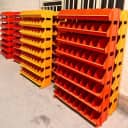
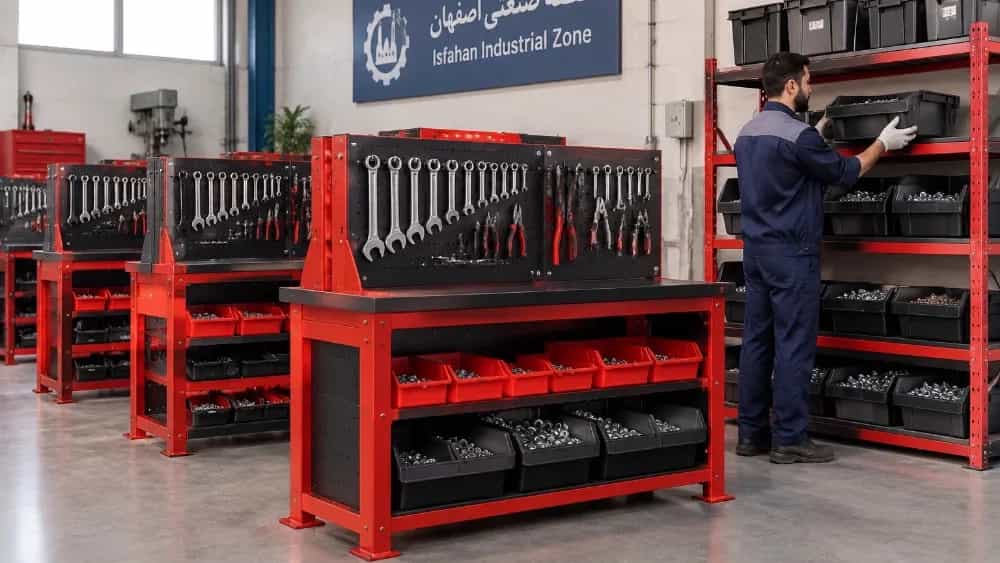
The low carrying capacity of normal shelves and the deformation of the sheet against the heavy weight of bolts and nuts are the most important challenges of equipping stores and industrial workshops. Mehrdad Etisalat Stand, as a specialized center for the production of metal stands and tool holders in Isfahan, produces these structures based on reinforced profiles, blessed steel sheets with real thickness and electrostatic powder coating. The implementation of these standards has made it possible to customize the dimensions, separate the connections accurately, and bear concentrated loads of up to hundreds of kilograms for banks, tool shops, and production lines.
The challenges of equipping tool shops in Isfahan market and choosing the right material
Esfahan tools and equipment market, due to the concentration of heavy industries and workshops in areas such as Nawab Safavi Street, New Shahpur and nearby industrial towns, needs equipment beyond fancy and thin market shelves. According to our field evaluations in equipping more than a hundred hardware stores, the most common error of associates is using light sheets under 0.7 mm for the arrangement of heavy wrenches, drills, millstones and steel fittings. In less than six months, this wrong choice will lead to falling floors, loosening of the base, and finally the risk of the shelf overturning.
In Isfahan, access to first-class hot and cold sheet material of Mobarakeh Fould Complex creates a local competitive advantage; But the rolling method, the bending angle and the type of co2 welding determine whether a stand can withstand the asymmetric load of industrial wrenches or not. Operational experience shows that ST12 standard oiled steel sheet, when bent with CNC brake, increases the moment of inertia of the section and the structure gains double mechanical resistance without unnecessary extra weight. Etisalat Mehrdad Stand has based the chassis structure of this equipment on the same engineering principle so that the useful life of the racking reaches more than ten years.
Engineering architecture, metal tool holder; The difference between industrial sheet and commercial style models
The difference between an engineering tool holder and various samples is not only in its painted appearance, but also in the arrangement of punches, the thickness of elastics and the depth of the floors. A wall or standing tool holder should be able to hold a wide variety of hand tools to heavy power tools such as a concrete drill.
Optimal design of drilling and punching Regal
Bean, circular or hexagonal punches should have a standard axial distance from the edge of the sheet. If this distance is not observed correctly, when hanging the heavy ring spanners grade 32 and above, the opening of the punch will come and the Regal hook will fall. The use of hydraulic Sembematrix molds in the Mehrdad production line ensures that no pleats or residual stress remain at the edge of the holes.
Bearing columns and weight distribution system
In the construction of self-standing stands, columns are welded from 40 x 40 cans or special profiles with a thickness of 1.5 to 2 mm. The use of reinforcing elastics under each arm and the design of adjustable steel bases, even on the uneven mosaic surfaces of old workshops, guarantee the 100% level of the structure and prevent vibrations caused by removing and placing tools.
Specialized stands for bolts and nuts; Load calculations and standard dimensions
Nuts and bolts are one of the densest items stored in a hardware store. A plastic or metal box full of M16 grade 8.8 or 10.9 steel dry screws can weigh more than 30 kg alone. Placing ten rows of these boxes on a stand means that the structure must bear at least 300 to 500 kg of concentrated dead weight on a floor area of less than half a square meter.
In the specialized center of Etisalat Mehrdad in Isfahan, calculations of the strength of materials are done before entering the cutting phase. Floors of bolt and nut stands are equipped with transverse bridges of reinforcement (so-called floor restraints). These bridges transfer the pressure from the bottom of the toolbox to the vertical columns to prevent the floor from buckling. In addition, the front edge of the floors has a safety reverse bend to prevent the junction boxes from sliding out during busy customer visits.
Separation of sizes also requires a suitable viewing angle of the buyer; Therefore, in the classified models of Mehrdad, the floors are installed with a calculated slope of 10-15 degrees forward so that the coding of the goods, the sizing of the thread and the height of the screws can be identified by the user in a fraction of a second.
Technical parameters | Mehrdad screw and connection stand (workshop) | Mehrdad wall tool holder and stand | Miscellaneous market samples |
Steel sheet and grade | Mubarake steel thickness 1.5 to 2.5 mm | ST12 oil sheet thickness 1 to 1.25 mm | waste or thin sheet 0.6 to 0.7 mm |
pillar profile type | Reinforced industrial 40x40 box | Light profile 20x40 and Percy studs | Light pipe or plain belt sheet |
Maximum load Each floor | 80 to 120 kg actual distributed | 35 to 50 kg hanging point | Maximum 15 to 20 kg |
painting technology | 200 degree furnace electrostatic powder | furnace anti-scratch polyester powder | manual or pistol air-dry paint Thin |
Adjustability and modularity | Has (M12 steel base adjustment screw) | Has (movable horns and easy to move) | No brittle plastic mounting base or screws |
Abrasion/impact resistance | Extremely high for sharp and cutting parts | High in Like hammer and wrench falling | Weak (peeling in the first month) |
Furnace electrostatic powder paint coating; Absolute protection against wear and rust
Industrial environments and Etisalat warehouses in Isfahan are facing the challenge of metal dust, periodic humidity and constant friction of winning parts. The use of traditional or air-dried oil paints in such conditions is completely rejected, because with the first impact of the box box or the impact of the wrench, the paint will be chipped and the steel substrate will be exposed to oxidation.
The standard production approach in Mehrdad complex relies on acid washing and degreasing cycle, metal surface phosphating and then robotic spraying of electrostatic powder paint with a uniform thickness of 60-80 microns. Then the pieces are baked in conveyor ovens at a temperature of 200 degrees Celsius. This process creates three critical characteristics:
- High resistance to scratches caused by moving heavy cartons of connections
- Excellent stability against spilling of industrial lubricants, grease and petroleum-based solvents
- No color change in the vicinity of sunlight behind the glass of shops and semi-open industrial warehouses
Comparison of direct purchase from Isfahan production workshop with market intermediaries
Purchasing directly from the local producer makes a significant difference in the final budget of setting up the store and workshop. Intermediaries often offer ready-made models with fixed dimensions, which have no flexibility to match the height of the ceiling or the thickness of the walls of the shop. In addition, warehousing and frequent shipping costs in the dealer chain are added to the final price.
Direct communication with the Mehrdad Etisalat stand production line enables customized design based on the sketch of the place. If a store has disturbing columns or needs to connect the screw stand to the power tool shelf, the technical drawing is sheeted and produced based on the centimeter dimensions of the space. Local support in Isfahan province and nearby areas (such as Yazd, Chaharmahal, Bakhtiari and Kashan) reduces the delivery speed from a few weeks to a few days and minimizes the costs of packaging and intercity freight.